Legal Interpretation of Balcony, Porch, and Patio under Thai Building Control Law
Legal Interpretation of Balcony Porch Patio Under Thai Building Control Law
External architectural elements such as balconies, porches, and patios play an important role in Thai building design and usability. However, from a legal standpoint, these structures may affect building area calculations (Floor Area), setback requirements, safety standards, and construction limitations under zoning regulations and local municipal ordinances.
This article aims to provide legal explanations and interpretations of these three types of spaces based on the Building Control Act B.E. 2522 (1979), relevant ministerial regulations, local notifications, and basic civil law principles.
1.1 Legal Definition
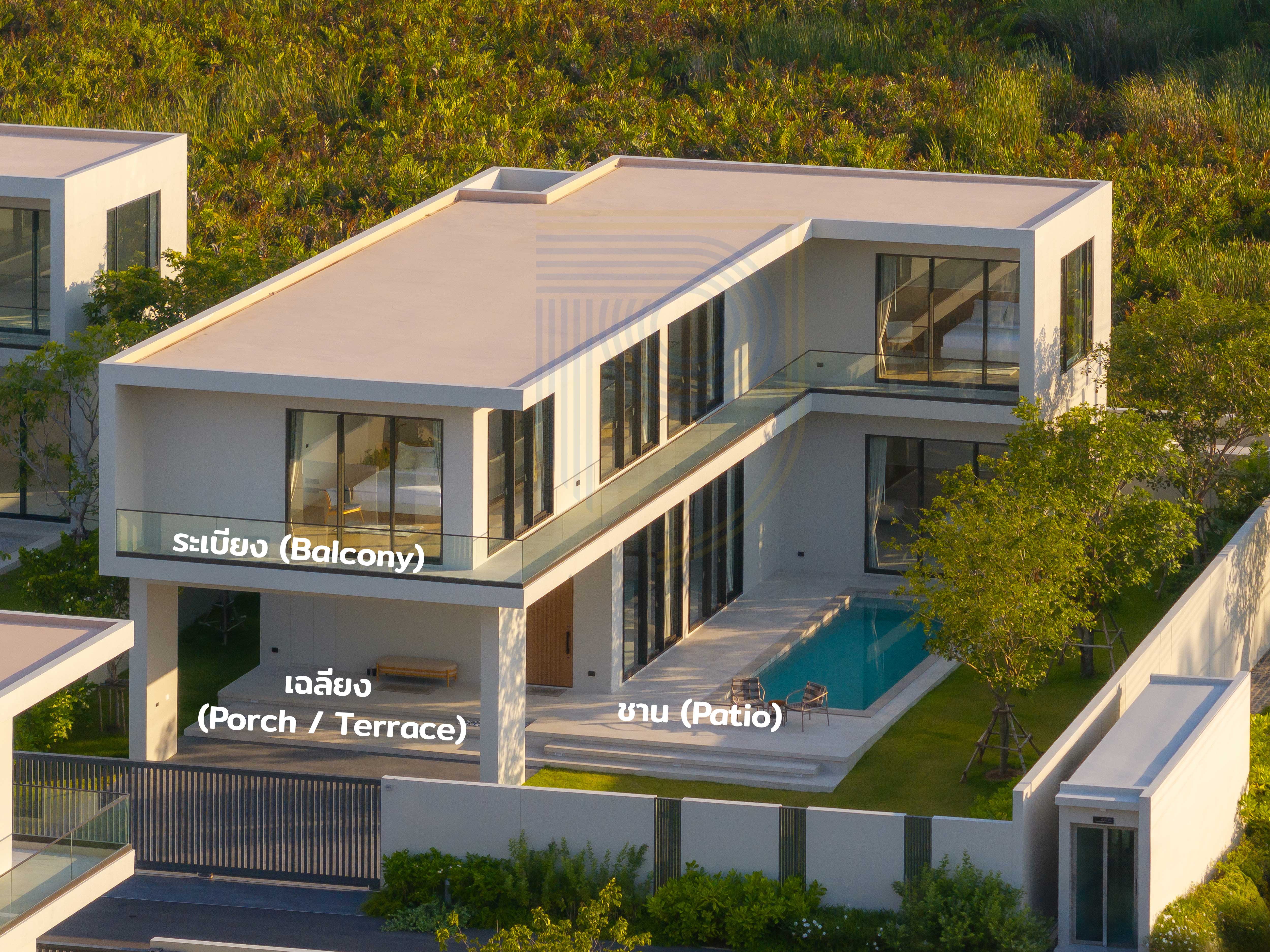
A balcony refers to a space that projects outward from the building structure and includes a guardrail for safety. Typically located on upper floors, balconies are subject to strict requirements concerning structural safety.
1.2 Requirements Under Building Control Law
According to the Ministerial Regulation on Building Characteristics and Materials B.E. 2549 (2006):
- Balcony guardrails must be at least 1.00 meter high.
- The spacing between balusters must not exceed 10 centimeters, ensuring child safety.
- Materials used must be strong, impact-resistant, and capable of preventing falls.
A balcony is considered a building projection, which must comply with setback and projection rules under municipal laws. Examples include:
- Projections must not extend beyond the property boundary.
- Projections over public land may be restricted or prohibited depending on local regulations.
1.3 Possible Legal Consequences
- A balcony built beyond approved plans or encroaching on adjacent property may be ordered to be demolished.
- Substandard guardrails may classify the structure as an unsafe building under the Building Control Act.
2.1 Legal Definition
A porch is a semi-outdoor space typically located on the ground floor and connected to the main entrance of a house. If the porch is covered by a roof, it is legally considered part of the building area.
2.2 FAR and Building Area Implications
If a porch falls under the main roof or structural framework:
- It is counted as part of the total floor area.
- It affects the calculation of FAR (Floor Area Ratio) and OSR (Open Space Ratio).
- It must comply with setback distances prescribed in zoning regulations.
Roof extensions over a porch must comply with legal provisions:
- Roofs cannot extend beyond the property boundary.
- Projections must not exceed legally defined building lines.
- Rainwater must not drain onto neighboring land, as prohibited under Civil and Commercial Code Section 1337.
3. Patio (or Veranda) in Legal Context
3.1 Legal Definition
A patio is an open ground-level space such as a front courtyard, poolside deck, or outdoor sitting area. Generally, it is not considered building area unless roofed or enclosed.
3.2 Applicable Legal Requirements
Although not treated as structural building space, patios are still subject to certain legal principles:
(1) Water Drainage and Neighbor Impact
Under Civil and Commercial Code Section 1337:
Property owners must not cause water to flow from their land onto another persons property.
Therefore, patios must be designed with proper drainage.
(2) Adding Roofs or Canopies
If a patio is later covered by a roof, it becomes part of the building and must comply with:
- Setback rules
- Total floor area calculations
- Projection limitations
4.1 Unapproved Construction (As-built vs. Approved Plan)
Modifications to balconies, porches, or patios often occur after obtaining building permits. This may result in:
- Orders for corrections or demolition.
- Inability to obtain a Certificate of Building Completion (Form A.6).
- Problems with property transfer in housing developments.
4.2 Legal Implications under Property Management Rules
Adding balconies, extending porches, or roofing patios may violate juristic person regulations, such as:
- Prohibitions against altering the buildings appearance.
- Restrictions on structural modifications affecting safety or integrity.
- Requirements to obtain advance approval from the housing estate or condominium committee.
Conclusion
Although balconies, porches, and patios are common architectural elements in Thai homes, each carries distinct legal implications. Balconies are subject to the strictest structural and safety requirements; porches affect building area calculations and setbacks, while patios primarily involve drainage and civil-law considerations.
Homeowners, developers, and construction professionals should clearly understand these distinctions to avoid legal risks both during and after construction.